
If you had told me a year ago that I’d end up building a full bookkeeping application and that I would purposely avoid turning it into a hosted SaaS - I probably would have laughed. I’ve built websites for years, developed tools, taught workshops, and handled my fair share of client projects. But building bookkeeping software? That wasn’t on the 2025 plan.
And yet here we are.
Where It Started: The Messy Middle of Making Tax Digital
Like many self-employed people, I was navigating the UK’s Making Tax Digital rules, trying to make sense of what was required and what wasn’t. HMRC wanted digital record-keeping. Most platforms wanted monthly fees. And I wanted something very simple:
- A private space to track income and expenses
- A system I could rely on
- A tool that didn’t turn into a subscription trap
- Something I could fully own
Everything I found was either too expensive, too bloated, too cloud-dependent, or too far away from what a sole trader actually needs.
And like many developers, when the thing you want doesn’t exist…
you start building it.
The First Version I Built and Why I Scrapped It
The early version of MTDify had HMRC integration.
It connected to APIs, handled tokens, followed all the digital submission requirements.
On paper, it felt impressive.
In reality, it felt heavy.
Building a hosted SaaS means uptime pressure, ongoing monitoring, data liability, endless security demands, and it wasn’t something I wanted to be responsible for every day. That version taught me something vital:
Just because you can build something, doesn’t mean you should run it as a SaaS.
So I stripped everything back.
Removed the entire HMRC integration.
Deleted models, tokens, fraud prevention headers, and multi-tenant logic.
I kept only what mattered: a clean, simple bookkeeping system.
The Pivot: An Offline-First Micro-SaaS
I realised something important: People don’t need another cloud bookkeeping platform.
They need ownership.
A tool they can install once.
A private place to keep digital records.
Something that doesn’t collect their data.
Something they don’t have to “trust” because it never leaves their device.
That’s when MTDify became a offline-first micro-SaaS - a term that sounds like a contradiction, but actually describes it perfectly.
It’s micro-SaaS because it solves one niche problem
It’s software-for-one because you own it entirely
It’s offline-first because it runs on your computer
I wanted to call it local-first but it missed one component. The ability to sync across devices. Once it has that - if I decide to include it - then it will be local-first. The great news is:
- You don’t create an account.
- You don’t send data to me.
- You don’t rely on servers staying online.
It’s bookkeeping the way it should be.
What MTDify Actually Does (and Doesn’t Do)
The Local Edition includes everything a UK self-employed person needs to keep clean digital financial records:
Add income and expenses
Organise categories
View dashboards
Track quarterly totals
Export CSVs
Store everything in a local SQLite file
Run entirely offline
Install with a single run script
The Starter Edition is a free digital bookkeeping edition and includes the ability to add income, expenses and categories. Great for hobbyists or people just starting out.
The Demo Edition - this is the original SaaS product. I decided to leave it up and make use of what I had built. If you don't want to install anything but you want an idea of how it works you can log in and use the demo using fake dummy accounts of course!
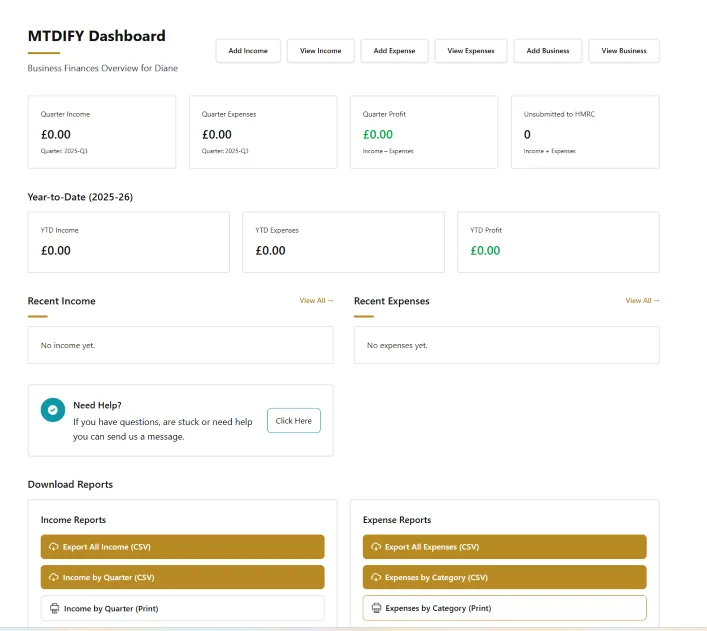
That’s it - and that’s the beauty of it. The focus is simplicity and privacy.
Nothing more. Nothing less.
Adding the Power Features — Only When They Made Sense
After refining the core, I added two powerful time-saving features to the paid Local Edition:
Recurring Monthly Entries
Rent, hosting, insurance, subscriptions - they appear automatically, saving hours each year.
Automatic Backups
Looking after the database is super important and backups to a cloud space is recommended but rather than rely on a person to remember backups are created automatically and can then be moved.
Offline-first. Private. Useful.
These became the “premium” features not because they’re locked behind a wall, but because they genuinely save time and elevate the experience.
Why I’m Proud of This Build
This project represents more than software.
It represents a decision about how I want to work.
I didn’t want the pressure of constant uptime.
I didn’t want to manage people’s data.
I didn’t want to build another high-stakes SaaS that keeps me awake worrying about hackers.
What I did want was to create something meaningful:
- A simple bookkeeping tool for people like me.
- A private system that fits how small businesses actually work.
- A calm alternative to cloud-heavy accounting software.
- A product I can maintain without burnout.
And that’s what MTDify became.
What’s Next
From here, the focus is refinement:
- Improving the Local Edition
- Expanding documentation
- Offering an optional installation service
- Providing a Pro Edition with extra features like OCR scanner
- Continuing to build calm, private, local-first tools
Final Thoughts
Building MTDify taught me something important:
Sometimes the most powerful choice is the simplest one.
Instead of chasing the biggest version of a product… I chose the right version for me. In the process, built something I’m genuinely proud of - a tool that reflects how I want to work, what I value, and what I believe software can be.
If you’re self-employed and want a simple, private bookkeeping system you can run on your laptop, you can learn more at MTDify.uk.
Thanks for sharing:
Download PDF Here
From Overwhelm to Ownership: The Story Behind Building MTDify
Download PDF Document


